Built for airports. Solving a real problem.
Indoor navigation in airports has been broken for a long time — either too expensive for most airports to deploy, or too friction-heavy for most passengers to adopt. GlidePath Air exists to fix both sides of that equation at once.
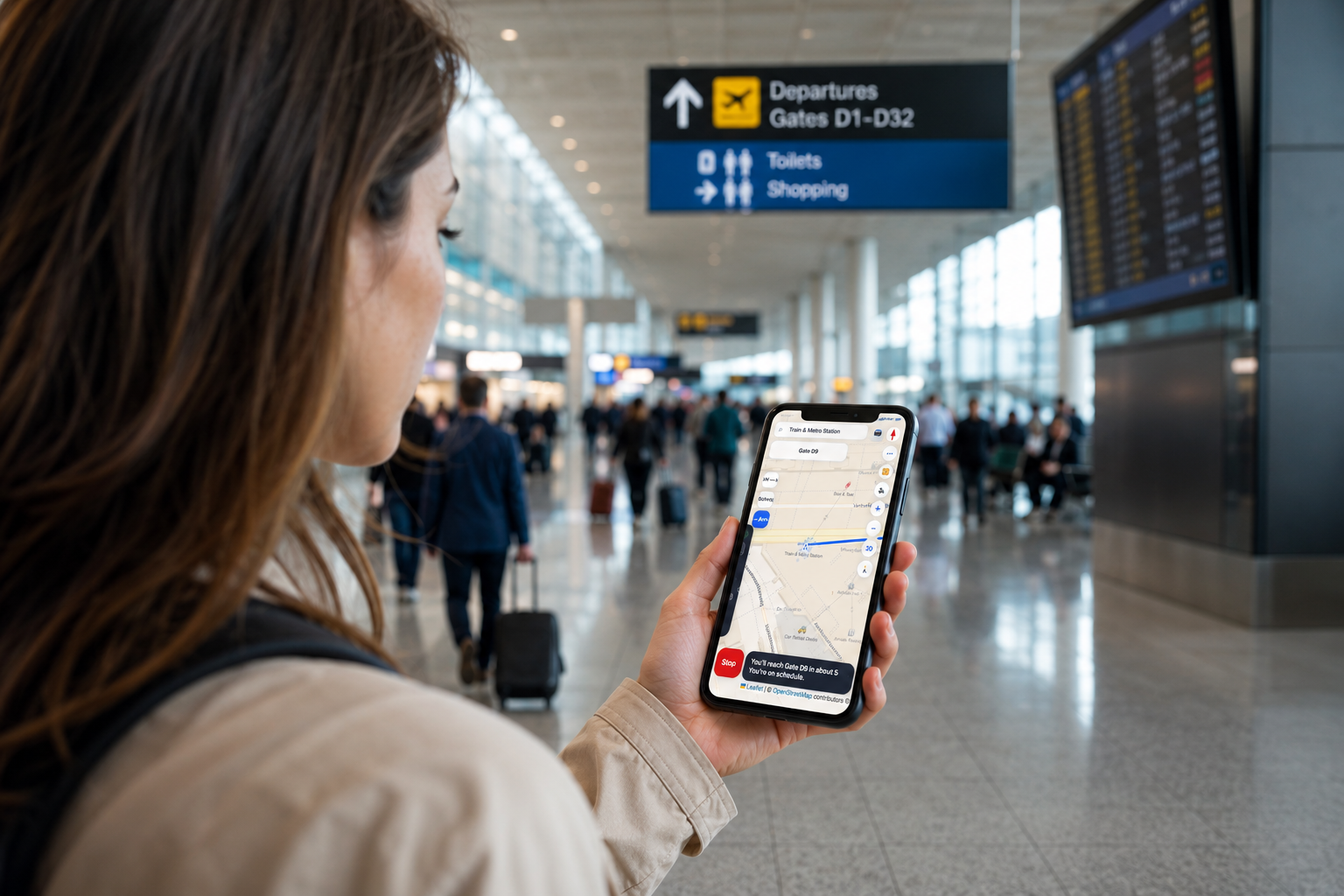
How we got here
GlidePath Air started as a question: why does every indoor navigation solution for airports require either a massive hardware investment or a passenger willing to download yet another app?
The answer was that existing systems were designed around the technology available a decade ago — BLE beacons, native apps, dedicated SDKs. None of that is necessary today. The passenger interface runs in the browser. Routes are calculated on the server from the terminal graph. This page does not state a positioning-accuracy figure.
So we built it. No beacons. No app store. No hardware contract. A URL that opens in any browser and guides any passenger from entrance to gate — live at the first airport within weeks of starting.
An end-to-end platform, honestly described
The bullets below describe behaviour in this repository. They are not a passenger deployment, and they are not a pilot at a European airport. Depth varies: some paths are mature, some are first-version.
Navigate
Boarding pass scan, turn-by-turn routing, multi-floor path planning, gate mode ETA, gate-change auto-reroute, voice and haptic guidance, step-free route weighting for companions and strollers, a passenger-side accessibility profile picker (5 profiles), a flight-aware itinerary planner (free-time, reachable stops), and full multi-terminal connection routing (arrival→onward across terminals with security/passport checkpoints and a feasibility risk band). A dedicated transfer-passenger mode toggle is on the roadmap.
Insights
Nine analytics tabs: live, traffic, timeseries, operational, quality, destinations, heatmap, processing time, retail proof — plus a separate transfer-analytics view under Terminal Management. Live, Heatmap, Processing Time, and Retail Proof are mature; Traffic, Timeseries, Operational, Quality, and Destinations are first-version views. A built-in Power BI streaming push (env-activated) is live; webhook / CSV export are on the roadmap.
Retail
Safe excursion with real-time window calculation, hours-aware shop routing, automatic recall (visual + haptic + voice), per-shop dwell funnel, scoped retailer dashboard with editable offer copy, and commercial-priority feeding the side-quest ranker. The excursion window already extends when a delayed departure time updates; automatically re-showing the offer on a delay is on the roadmap.
Admin Platform
Web-based floor plan editor, graph builder, POI manager, route simulator, live position monitor, and reporting dashboard — no specialist software required.
Privacy
This page does not claim GDPR compliance or that boarding passes are processed only on the device. What is stored depends on the code that is deployed and on that environment's configuration.
No pilot claimed
This page does not describe field testing, a Romanian airport customer, or a scheduled passenger pilot.
How we make decisions
Remove friction, not features
Every feature is evaluated against one question: does this add friction for the passenger or the operator? If yes, we redesign it. Simplicity is not a trade-off — it is the goal.
Only claim what is built
We do not roadmap features we have not started. Every capability listed on this site is working code we have already built and tested. We earn trust by shipping, not by promising.
Privacy by default
Passengers do not need accounts for navigation. Boarding-pass names are not stored, and operational events use pseudonymous session identifiers with configurable retention. Privacy remains an engineering and governance responsibility.
Open to integration
We stream data to your existing BI tools rather than asking you to replace them. We integrate with your flight data sources rather than building a closed data silo.